
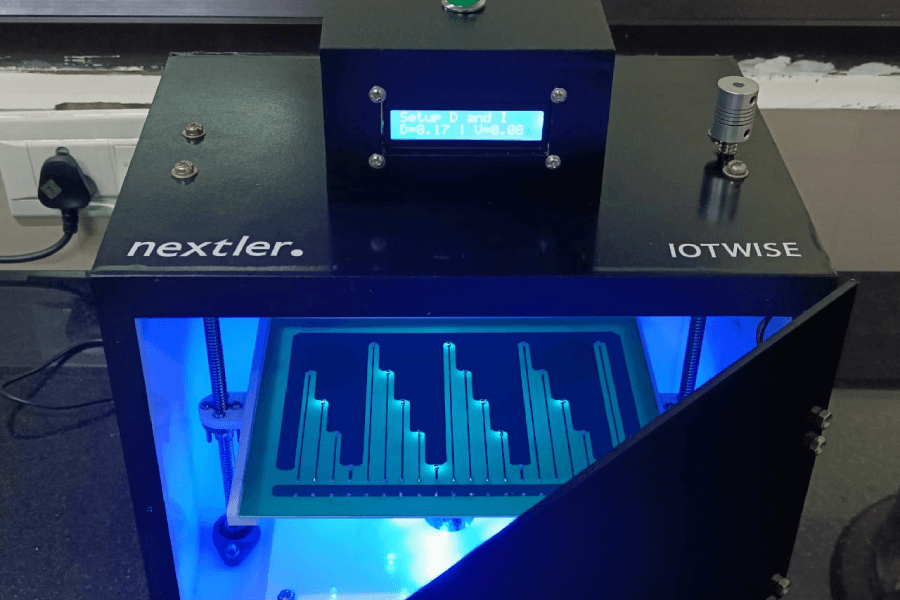
During the 2023–24 period, one of the most exciting and impactful projects undertaken by Nextler Innovations was the integration of an IoT system into a research equipment developed for antibacterial photodynamic inactivation. This project was executed in collaboration with the Central Institute of Fisheries Technology (CIFT), Wellington Island, Kochi, Kerala.
From Standalone Equipment to Connected Research Infrastructure
We worked closely with the research team at CIFT in the development of this specialized equipment. While the initial project scope did not include IoT integration, our team proposed an enhancement: enabling experimental data to be pushed securely to the cloud. This would allow researchers to access, document, and analyze data efficiently for both current experimentation and future reference. The proposal was well received, and we subsequently designed and implemented the IoT architecture for the system.
System Architecture and Key Components
The equipment comprises multiple integrated subsystems designed to support precise experimentation and data collection:
- Lighting Unit: Features replaceable LED boards, allowing researchers to test LEDs of different wavelengths for varied experimental requirements.
- Height Adjustment Mechanism: Enables precise control of the distance between the light source and the target, helping researchers study the effect of irradiance variation with distance.
- Temperature Monitoring System: A real-time temperature sensor continuously measures the internal chamber temperature.
- Active Cooling System: Dual DC fans regulate internal temperature, ensuring stable experimental conditions.
- Light Intensity Sensor: Measures the irradiance of light falling on the target, a critical parameter in photodynamic studies.
- Display and User Interface: An integrated display provides real-time readings and acts as the primary user interface, enabling researchers to navigate through experimental stages seamlessly.
IoT Workflow and Cloud Integration
Once an experiment is initiated, the device automatically searches for a Wi-Fi connection to establish internet access. Researchers then configure the experimental parameters and begin the experiment using the onboard navigation controls.
Upon completion, all experimental data—along with a unique experiment ID—is securely transmitted to the cloud. Authorized researchers can log into the Nextler IOTWISE platform using their credentials to view, analyze, and compare data across experiments.
Impact and Benefits
The IoT integration significantly enhances the research workflow by:
- Enabling real-time monitoring of experimental data
- Supporting efficient documentation and data traceability
- Allowing research guides to supervise progress remotely
- Helping future researchers avoid redundant experiments, thereby saving time and resources
Overall, this transformation from a standalone device to a connected research platform adds long-term value to the research ecosystem.
Looking Ahead
At Nextler Innovations, we specialize in building IoT-enabled, research-grade solutions that bridge the gap between hardware innovation and digital intelligence. If your organization is exploring smart, connected systems for research, industrial, or commercial applications, we’d be glad to collaborate.
Learn more about our vision and How Nextler IOTWISE can help scientific research institutions around the globe deliver results better?
📩 Contact us:
Email: contact@nextlerinnovations.com
Phone: +91 70128 21694
